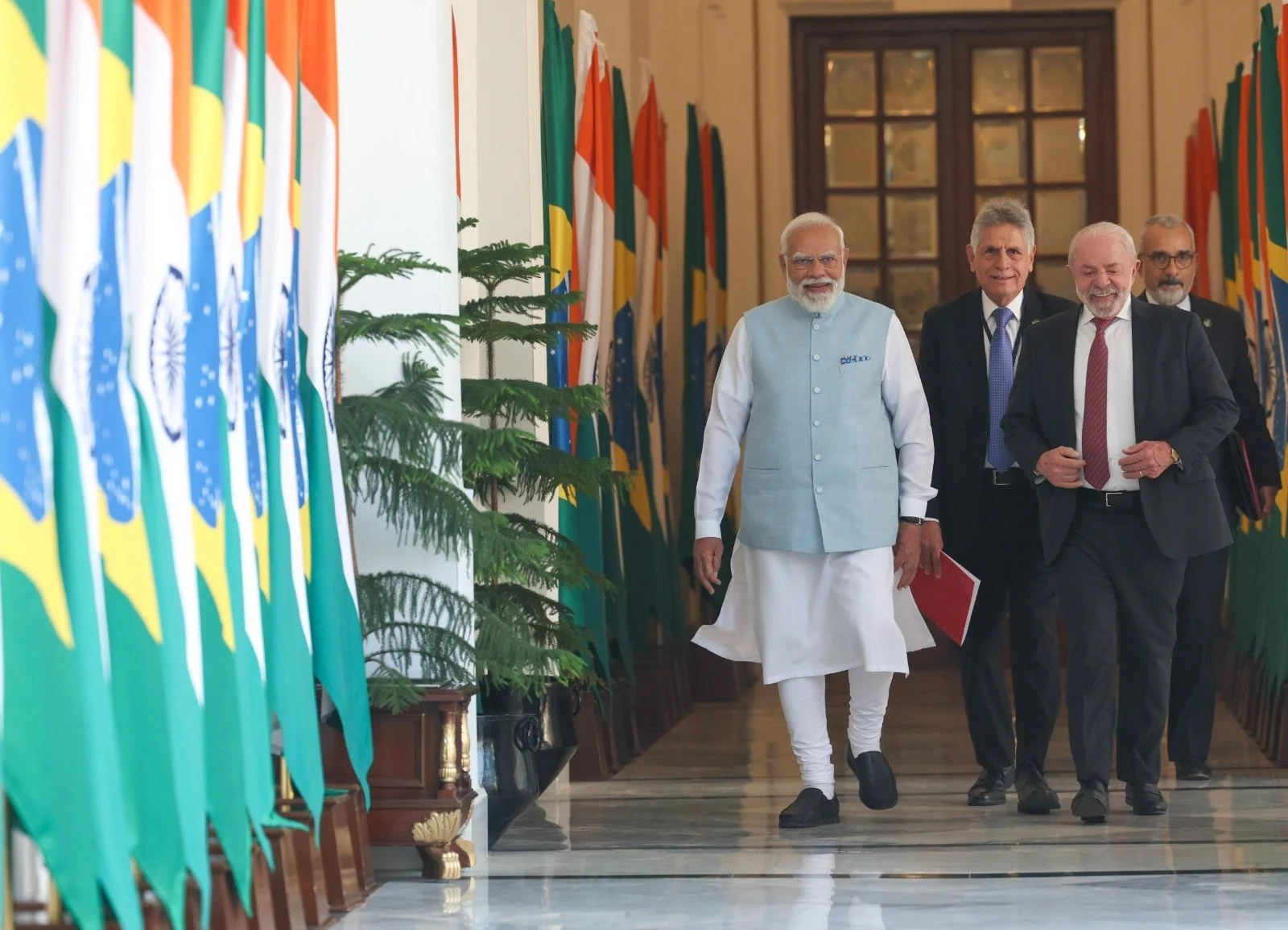
India-Brazil Synergy
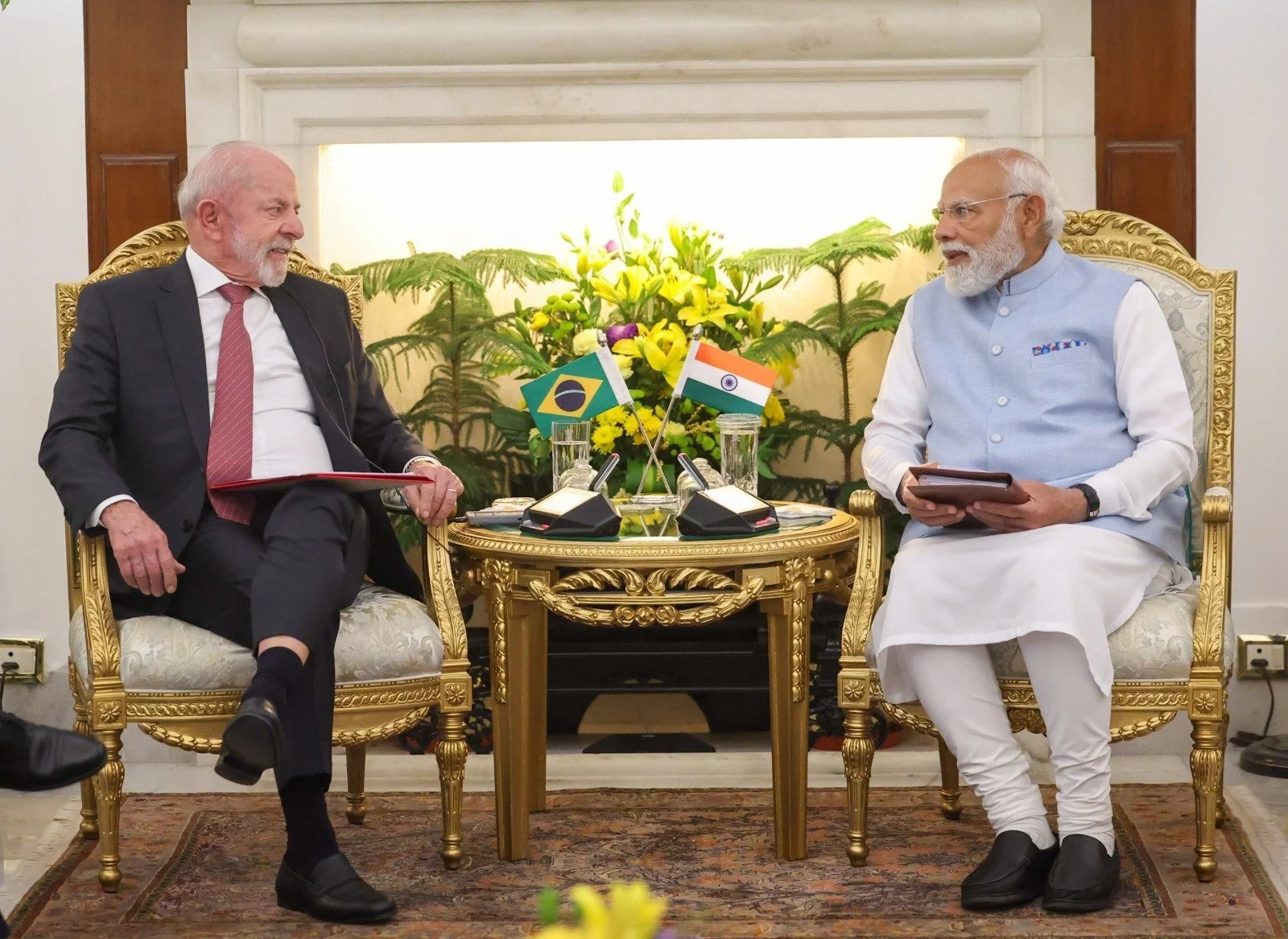
The Long Awaited Visit
President Lula's February 2026 state visit to India represents significant progress in bilateral relations but falls short of the transformational breakthrough both sides rhetorically claim. The tangible outcomes—particularly the critical minerals MoU and defense cooperation framework—provide foundation for deeper strategic convergence. The visit's symbolism, with Lula's evocative language about 'the digital world returning to its homeland' and Modi's emphasis on amplifying the Global South voice, captured both leaders' aspiration to position India-Brazil cooperation as exemplar of South-South partnership.
President Lula arrived in New Delhi on February 18, 2026, for a five-day state visit (concluding February 22), accompanied by a substantial 14-minister delegation and over 300 business executives—the largest Brazilian business contingent ever to visit India (India TV, 2026). The composition of the delegation signaled serious intent: ministers representing mining, agriculture, digital economy, renewable energy, foreign affairs, and defense indicated Brazil's prioritization of substantive cooperation over symbolic engagement.
The Global South Comradirie
Both Modi and Lula have positioned themselves as champions of the Global South—a loosely defined coalition of developing countries seeking greater representation in international institutions, fairer trade rules, climate justice, and South-South cooperation as an alternative (or complement) to North-South aid relationships. India's G20 presidency in 2023, with its theme 'One Earth, One Family, One Future' and inclusion of the African Union as a permanent member, exemplified this approach. Brazil's G20 presidency in 2024-2025, emphasizing reform of multilateral development banks and addressing global inequality, continued this trajectory.
The India-Brazil partnership thus transcends bilateral utility—it represents an attempt to build institutional capacity for Global South collective action. As Prime Minister Modi stated at the joint press conference: 'When India and Brazil work together, the voice of Global South becomes stronger and more confident' (MEA, 2026). President Lula echoed this sentiment: 'India and Brazil are crucial voices at the UN, at the WTO and G20.
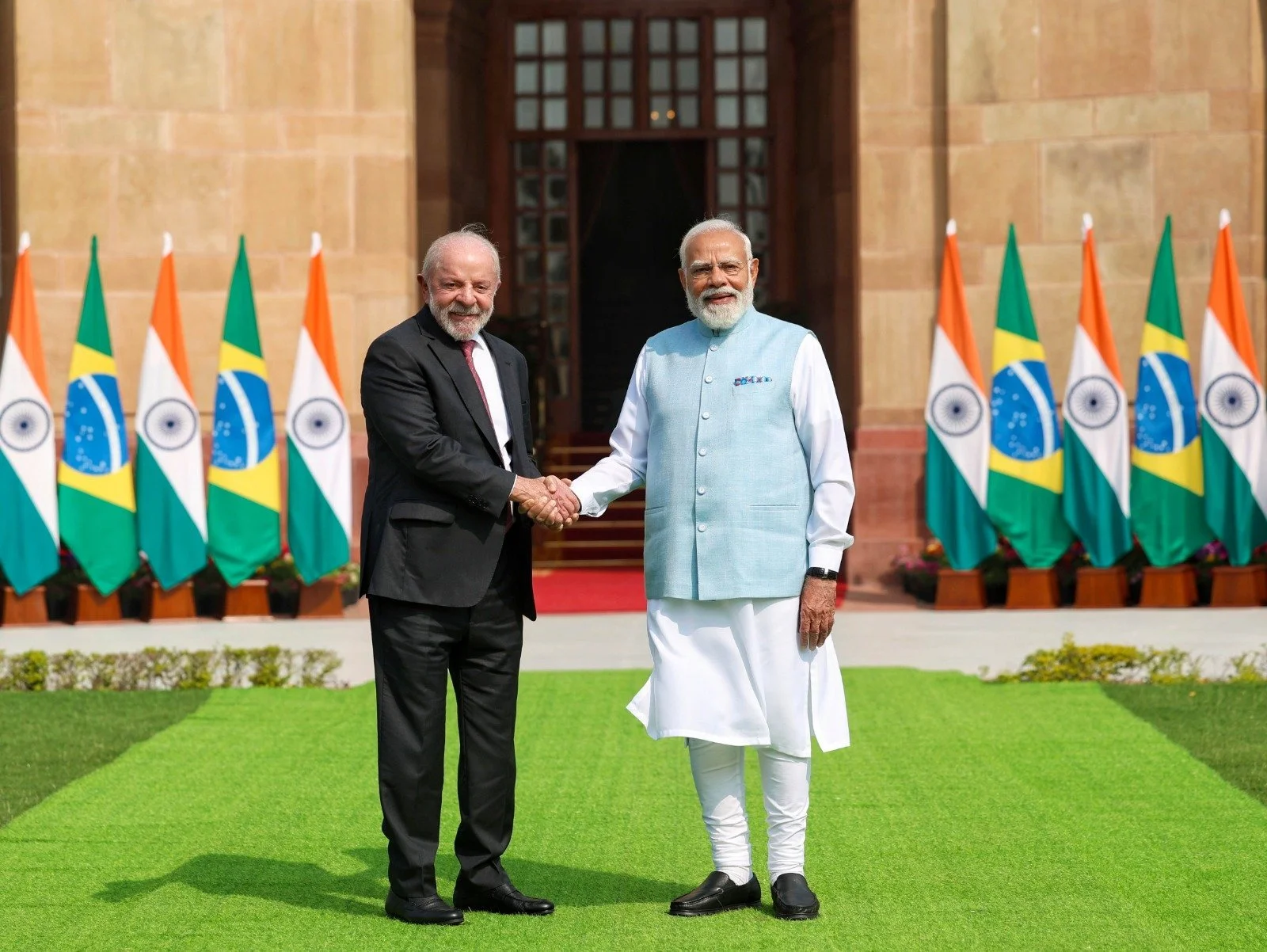
Agreemtns Reached
The bilateral summit produced ten formal agreements between governments, spanning strategic, economic, and developmental cooperation. Out of this various agreements, the critical minerals agreement represents the visit's most strategically significant outcome. China controls approximately 70% of global rare earth processing capacity and over 80% of permanent magnet production, creating acute vulnerabilities for countries pursuing clean energy transitions and defense modernization. Brazil's niobium reserves (90% of global production), lithium deposits in Minas Gerais, and rare earth potential in Araxá and Serra Verde offer India tangible diversification opportunities.
Beyond governmental MoUs, seven private-sector agreements were signed during the visit, reflecting growing commercial confidence. this included Embraer-Adani Defence & Aerospace cooperation, especialy that of E175 Aircraft Final Assembly Line in India. This represents Embraer's most significant manufacturing presence outside Brazil.
Major concerns
India and Brazil have signed numerous agreements over the past two decades, many of which remain on paper due to bureaucratic inertia, insufficient funding mechanisms, and absence of accountability frameworks. Brazilian exports to India consist overwhelmingly of primary commodities (sugar, crude oil, vegetable oils, cotton, iron ore) while Indian exports comprise manufactured goods (pharmaceuticals, automotive components, machinery, textiles). This commodity-manufacture asymmetry creates vulnerability to price volatility and generates limited value-added employment in Brazil—a concern Lula's administration has privately raised.
The partnership faces major geographical and structural barriers: such as - 15,000 km distance, no direct flights - Only 14% Brazilian exports covered by PTA - Minimal people-to-people connections - China’s dominance in Brazil ($150B vs. $15B). A significant unresolved issue is expansion of the India-Mercosur Preferential Trade Agreement. The existing PTA covers merely 450 tariff lines—far too limited to substantially boost bilateral commerce. Both sides acknowledged the need for expansion, with President Lula explicitly referencing 'trade unilateralism' (an oblique reference to US tariff policies) as impetus for deeper India-Mercosur engagement. Brazil, conversely, seeks greater market access for its agricultural exports while remaining wary of Indian manufactured goods flooding Mercosur markets.
Educational and Cultural Exchanges
Unlike US-India (4 million diaspora strengthens ties), India-Brazil lacks organic people linkages - Requires deliberate government efforts -such as visa relaxation and direct flight connectivity. Both nations agreed to expand educational exchanges, building on existing partnerships between IITs (Indian Institutes of Technology) and Brazilian universities like USP (University of São Paulo). The agreement commits to scholarships for STEM students, joint research programs, and faculty exchanges. President Lula's AI Summit speech referenced ancient Indian mathematical contributions, demonstrating cultural diplomacy's soft power dimensions. However, language barriers (Portuguese-English-Hindi) and visa complexities continue constraining people-to-people flows. The Indian diaspora in Brazil, though numerically small (approximately 10,000-15,000), plays disproportionate economic role concentrated in São Paulo's IT and pharmaceutical sectors.
The world’s two largest democracies have all the ingredients for transformation. The question is whether they can overcome geography, bureaucracy, and inertia to realize the promise. As PM Modi said: “Brazil and India are two superlative democracies with shared values.” Given the quality of leadership (Modi-Lula rapport), odds favor success. But execution, not just vision, will determine if India-Brazil becomes a strategic partnership of substance or remains a symbolic partnership of aspiration.