INDIA-EU Trade Deal

Image Copyrights applied.
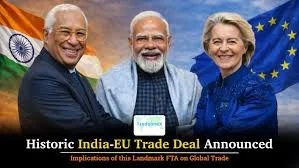
Known as the “mother of all deals”, the India-EU Free Trade agreement is being described as a generational shift by the European Commission President Ursula von der Leyen. The agreement, nearly two decades in the making after talks began in 2007, was finally signed in January 2026 in New Delhi, India. The FTA is expected to provide duty-free or preferential access to a wide range of Indian goods, particularly from labour-intensive sectors such as textiles, chemicals, gems and jewellery, electrical machinery, leather and footwear. Under a typical FTA framework, the two sides would reduce or eliminate import duties on more than 90% of goods traded. The EU is India’s largest trading partner in goods. Bilateral goods trade stood at $136.53 billion in 2024/25, with Indian exports worth $75.85 billion and imports at $60.68 billion, giving India a trade surplus of $15.17 billion. Services trade between the two reached $83.10 billion in 2024. The EU accounts for about 17% of India’s total exports, while India absorbs roughly 9% of the bloc’s overseas shipments.
Europe is the new "Natural Partner"?
The so called mother of all trade deals, the EU-India FTA is a great development for both side. it is seen as a win-win deal for consumers of both sides. The negotiations have been notoriously difficult, restarting after a long pause in 2021. Key sticking points have always been the Market Access: The EU wants India to drastically cut import duties on goods like cars, wine, and dairy. India is protective of these sectors. Sustainability Clauses: The EU wants binding commitments on labor rights and environmental standards (e.g., the Paris Agreement), which India views as potential protectionist tools. Data & IP: Issues around patent protection and cross-border data flows are complex points of negotiation.
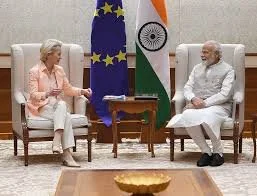
When you have the Chancellor of Germany, the President of France, the entire top leadership of the European Commission and Council, and the leaders of nearly a dozen other nations in New Delhi within a span of eight weeks, it sends a powerful signal to the rest of the world. Under Modi’s doctrine, India has emerged as a voice of the Global South. We are the bridge between the Global north and the Global South. If you want access to Western technology and markets on fair terms, the road may lead through New Delhi. India is seen as a responsible stakeholder that does not weaponize its interdependence.
Initially, the West's approach to India was reactive—a "Plan B" in case things went wrong with China. That has fundamentally changed. What began as a hedging strategy against China has now become a proactive, positive strategy for India. Leaders are no longer coming to Delhi just to talk about what they can avoid (dependence on China), but about what they can build (AI standards, digital infrastructure, green hydrogen corridors). Now EU has embraced India with both open policies. They recognize that the global energy transition cannot happen without India's massive market for green technology and its capacity for innovation in areas like green hydrogen. They want India at the table to set the rules for AI, data governance, and digital trade, ensuring that these rules remain democratic and open, rather than authoritarian and closed.
After souring of relations with Trump 2.0, India is moving faster to find a new natural partner, and EU is the front runner. Our observation is that both Europe and India find themselves in a similar position: they are huge markets and technological powerhouses in their own right, but they are not the creators of the foundational AI models (which are currently dominated by the US and China). A partnership allows them to Pool resources for research and development. Co-create standards for "trustworthy" or "ethical" AI, offering an alternative model to the US and Chinese approaches. Strengthen their supply chains for semiconductors and other critical AI hardware.
If this scenario plays out, it would mark the emergence of a "New Delhi Consensus" —a model of global integration that is distinct from the Washington Consensus (neoliberalism) or the Beijing Consensus (state-capitalism with authoritarian control). It would be based on:
Digital Public Infrastructure as a public good.
Strategic Autonomy rather than alliance membership.
Multi-alignment as a source of strength, not weakness.
Demographic and Technological dynamism as the foundation of growth.
The world is no longer unipolar, and it is fracturing into competing blocs. In this new landscape, India offers something no other country can:
The Demographic Counterweight: As the West ages and China's population declines, India is the only major economy with a growing, young workforce. For Western companies facing labor shortages at home and a shrinking consumer base in other markets, India is not just an opportunity; it is a necessity for sustained growth.
The Trusted Disruptor: The West needs a reliable partner in Asia that is not China. India is a democracy, has a common law system, and a diaspora that is highly integrated into Western societies (from CEOs to scientists). This "trust factor" is the bedrock upon which technology sharing and supply chain relocation are built.
India must now carefully calibrate its engagements to avoid creating new rivalries or resentments among its partners. The success of this moment will be measured not by the signing of agreements, but by their implementation and the trust built over time. The FTA with Europe, the depth of tech transfer with France, and the tangible outcomes of forums like the AI Summit will be the true tests of this historic opening.